The Choice That Changes Everything
I sat down with Dr. Khalid Mumin — Superintendent of Reading Public Schools, former Pennsylvania Secretary of Education under Governor Josh Shapiro.

Welcome to The Democratic Dilemma where we stop debating what needs to change and start building how to win.
This is Unfiltered Campaign Marketing for a New Generation — we demystify the how: winning in every district, defining real victory, building media that moves people (not algorithms), and developing leaders who ignite movements. Our mission? Floodlight the path forward. Justice doesn’t win elections, people do. We help you win real power, votes, volunteers, and small-dollar fuel on your terms, in your community.
🎙️ Join Mary Noone & Josh Stanley: Gen X Meets Gen Z — The Unlikely (But Brilliant) Power Duo
Think of us as the political equivalent of a 90s mixtape meeting a TikTok algorithm — we’re the odd couple who actually make the whole thing work. Mary’s has the playbook; Josh’s has the vibe. The future of politics isn’t about one generation leading the other, it’s about both showing up, bringing their best, and creating something that works for everyone.
Subscribe. Learn. Win. The future’s being built block by block —> by folks who refuse to ask permission.
Let’s get after it.
You’ve heard me say it before — culture eats strategy for breakfast. It’s time to change the culture of how we run our campaigns. And nowhere does this matter more than in the fight for public education.
Over the past months, I’ve sat down with some of the sharpest minds in education and child reform policy — Josh Cowen Bruce Lesley Andy Spears Stephen Dyer — and a disturbing pattern emerged across our conversations. If you live in a voucher-heavy state, your tax dollars are funding two education systems. One accountable to the public. One accountable to no one. And the money flowing away from neighborhood schools is leaving children behind.
But what if it didn’t have to be this way?
I sat down with Dr. Khalid Mumin — Superintendent of Reading Public Schools, former Pennsylvania Secretary of Education under Governor Josh Shapiro, and a man whose life story is the argument for why public education matters. Raised in Logan, the most underserved community in Philadelphia, Dr. Mumin credits education as the one tool that lifted his family out of poverty. He became a teacher, then principal, then superintendent — all before age 40, often the first African-American in these roles.
While other states are draining public school resources to subsidize private vouchers, Pennsylvania made a different choice. A choice to center the student, not the ideology. A choice to invest $1.8 billion in new education funding while building a fair funding formula that actually closes adequacy gaps between affluent and underserved districts.
Dr. Mumin put it plainly:
“Charter school students are our students. Not competitors. Not enemies. Our students. Pennsylvania’s charter law requires charter schools to offer programming beyond what traditional public schools provide — and to exceed public school achievement. That’s not a loophole. That’s accountability. That’s what success looks like.”
It’s a choice.
In this conversation, we dive into:
How Pennsylvania’s three-bucket funding system (federal, state, local) actually works to serve kids in underserved communities
Why locking students into career pathways in 7th grade fails them — and how on-ramps/off-ramps create real opportunity
The 10 Educator Commitments that transform schools from institutions into communities
How parents can create change at the local level — from building administration to school board to legislature
Why AI isn’t the enemy — and how educators must become lifelong learners to prepare students for a future we can’t yet imagine
The through line? When you center the student, everything changes. The politics soften. The partnerships deepen. The resources follow.
But here’s where the choice becomes crystal clear.
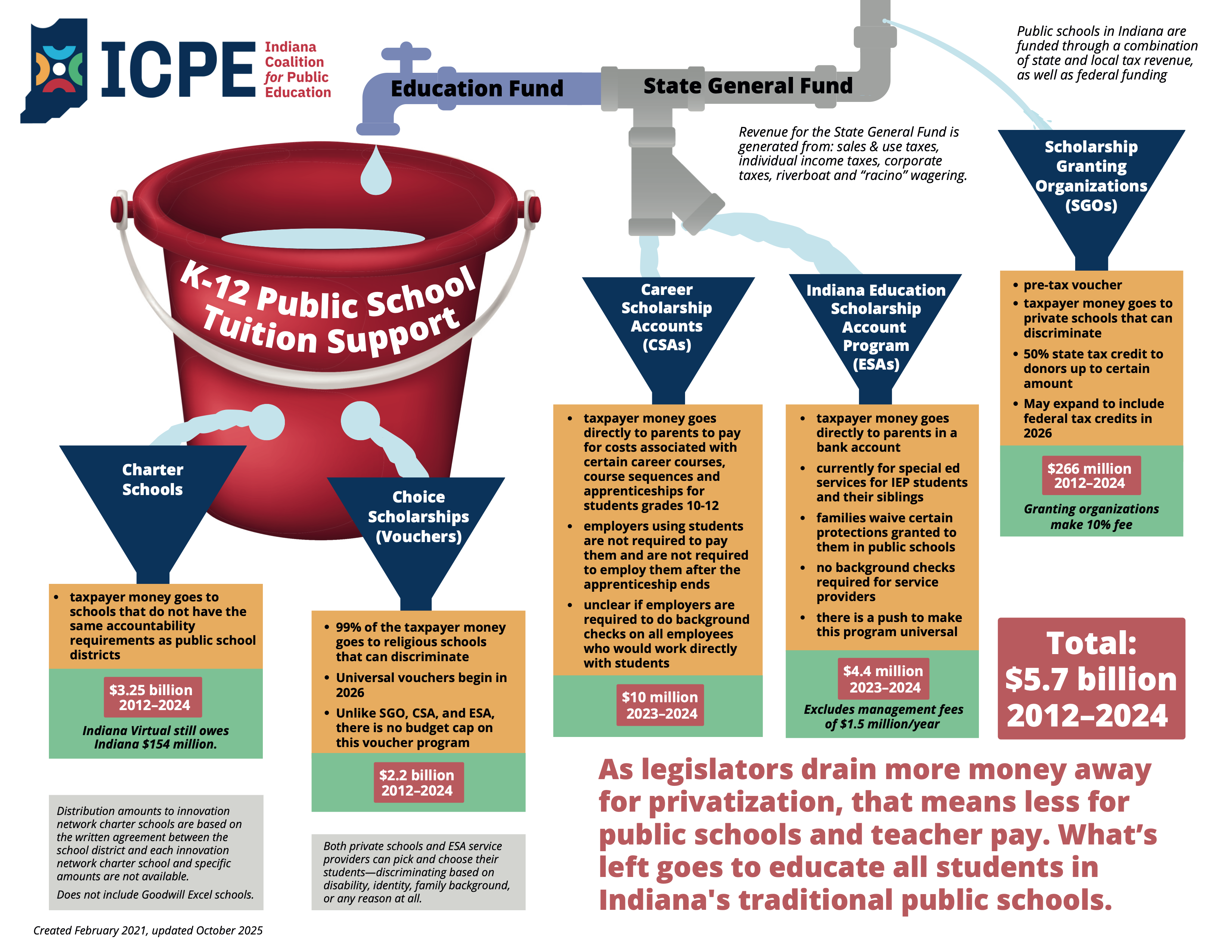
In Indiana, those three buckets — local property taxes, state income and sales taxes, federal dollars — aren’t just funding public schools anymore. They’re being siphoned off to fund a parallel system with no accountability. The graphic above follows the largest bucket, state tuition support, determined by legislators every biennium. But do you ever wonder how legislators can brag about “historic” increases in the education budget, yet public school funding increases barely keep up with inflation? ~ ICPE
It’s because so much is diverted out of the K-12 Tuition Support Fund before public schools get what’s left. Since 2012, $5.7 billion has flowed to voucher programs while public schools compete for the remainder. Private schools and ESA service providers can pick and choose their students — discriminating based on disability, identity, family background, or any reason at all. There are no background checks required for service providers. 99% of taxpayer money in some programs goes to religious schools that can discriminate. Indiana Coalition of Public Education advocates for separate line items for different forms of schools in the state budget so we can see where the money is spent. Currently, those don’t exist
This is the choice. Pennsylvania chose to center students and build partnerships. Indiana chose to drain public resources and fund privatization. Both states have the same three buckets. Different choices. Different futures.
We’re here to floodlight the path forward. What messaging will land with voters?
“Your tax dollars are funding two education systems.”
Dr. Mumin’s message is clear: Education is democracy. It’s the great equalizer. It’s not about left or right — it’s about right and wrong for our children. Funding public education is a choice.
Subscribe. Learn. Win. The future isn’t waiting. It’s being built, block by block, by the people who refuse to ask for permission to fight back.
Let’s get after it.
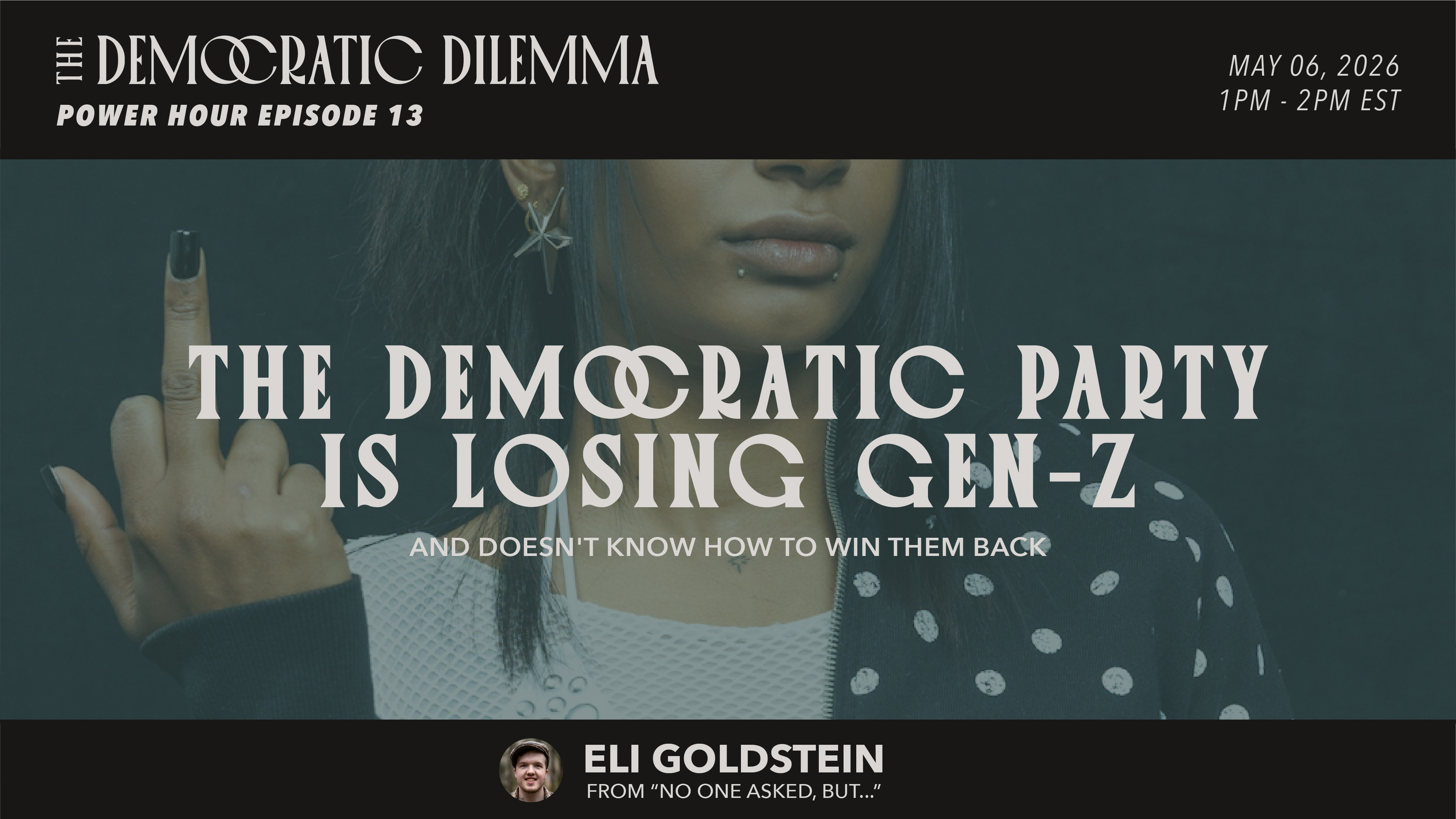
This afternoon at 1:00pm ET join us for another stimulating conversation :
The Democratic Party Is Losing Gen Z — And Doesn't Know How to Win Them Back - today I talk with Eli's Substack to discuss why?
Young voters didn’t just sit out the last election. They sent a message.
Turnout among voters under 30 dropped sharply. Polling shows record distrust in Democratic leadership. And yet, what’s the game plan? It’s mostly confusion, hand-wringing, and the same tired playbook that got us here.
That gap — between what Gen Z is telling us and what Democrats are hearing — is what we’re digging into on this week’s podcast.
TODAY - THURSDAY - 1:00pm
🔗 🔗 https://thedemocraticdilemmapowerhour.me/GEN-Z